You’ve learned what ETFs are. You understand the S&P 500. You know VOO is one of the most popular investments in the world.
But then someone mentions QQQ — and suddenly you’re wondering: wait, is QQQ better than VOO? Should I be buying that instead?
It’s one of the most common questions among beginner investors, and it’s a great one. Both VOO and QQQ are excellent ETFs — but they’re built differently, behave differently, and suit different types of investors.
Let’s break them down side by side.
What is QQQ?
QQQ is the ticker symbol for the Invesco QQQ Trust — an ETF that tracks the Nasdaq-100 index.
The Nasdaq-100 is a list of the 100 largest non-financial companies listed on the Nasdaq stock exchange. It’s heavily weighted toward technology — think Apple, Microsoft, NVIDIA, Amazon, Meta, and Tesla.
While VOO gives you broad exposure to 500 companies across all sectors of the U.S. economy, QQQ gives you concentrated exposure to 100 of the largest, most growth-oriented companies — with a strong tech bias.
VOO vs QQQ: The Key Differences
| VOO | QQQ | |
|---|---|---|
| Tracks | S&P 500 (500 companies) | Nasdaq-100 (100 companies) |
| Issuer | Vanguard | Invesco |
| Expense ratio | 0.03% | 0.20% |
| # of holdings | ~503 | ~101 |
| Top sector | Technology (~30%) | Technology (~60%+) |
| Includes financials? | Yes | No |
| Dividend yield | ~1.3–1.5% | ~0.6–0.8% |
| Best for | Broad diversification | Growth-focused investing |
The most important difference: VOO is diversified across all sectors. QQQ is concentrated in tech and growth.
Top Holdings Comparison
Here’s how the top holdings compare:
VOO Top 5:
| Company | Weight |
|---|---|
| Apple (AAPL) | ~7.0% |
| Microsoft (MSFT) | ~6.5% |
| NVIDIA (NVDA) | ~6.0% |
| Amazon (AMZN) | ~3.7% |
| Meta (META) | ~2.4% |
QQQ Top 5:
| Company | Weight |
|---|---|
| Apple (AAPL) | ~9.0% |
| Microsoft (MSFT) | ~8.5% |
| NVIDIA (NVDA) | ~8.0% |
| Amazon (AMZN) | ~5.5% |
| Meta (META) | ~4.5% |
You’ll notice QQQ has the same companies at the top — but with significantly higher weightings. And it excludes banks, insurance companies, and other financial firms entirely (that’s what “non-financial” means in the Nasdaq-100 definition).
Performance Comparison: Who Has Won?
This is where things get interesting. QQQ has outperformed VOO significantly over the past decade — largely because of the explosive growth of technology stocks.
| Period | VOO Return | QQQ Return |
|---|---|---|
| 1 year (2024) | +25% | +27% |
| 3 years (2022–2024) | +28% total | +24% total |
| 5 years (2020–2024) | +95% total | +135% total |
| 10 years (2015–2024) | +245% total | +420% total |
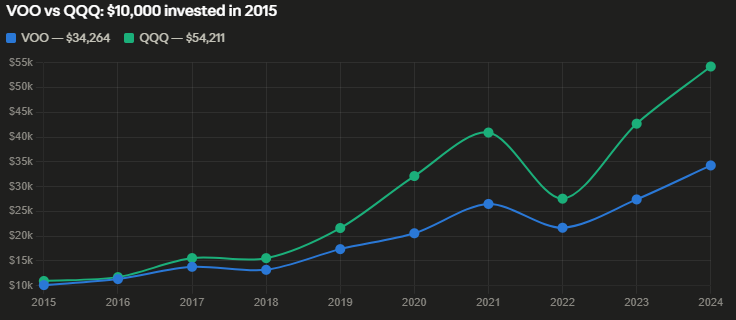
Source: Approximate annual returns for VOO and QQQ from 2015–2024. Past performance does not guarantee future results.
Over 10 years, QQQ nearly doubled VOO’s return.
That sounds like a clear winner — so why doesn’t everyone just buy QQQ?
The Catch: Higher Returns Come With Higher Risk
Here’s what the long-term return comparison doesn’t show you clearly: QQQ is significantly more volatile than VOO.
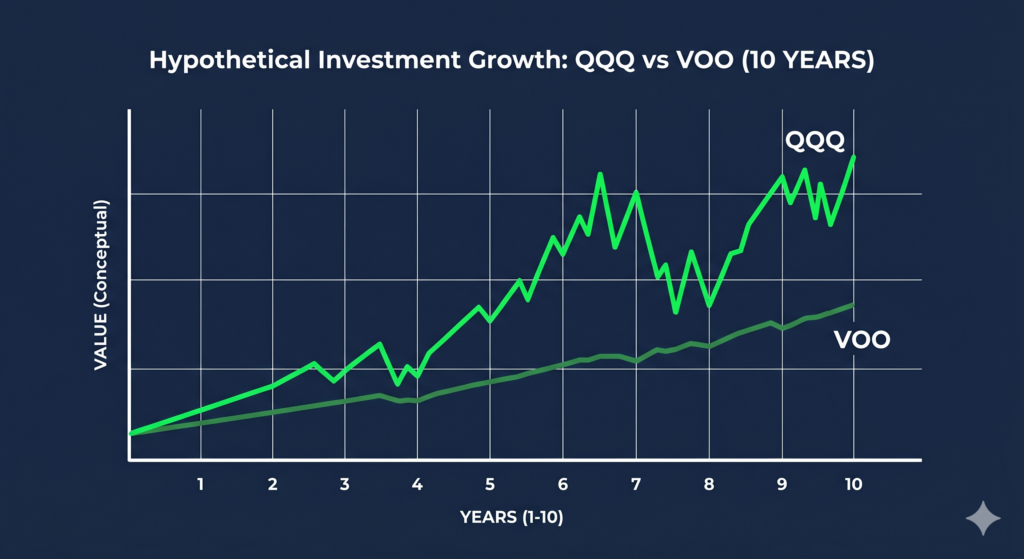
When markets sell off — especially tech stocks — QQQ drops harder and faster than VOO.
| Downturn | VOO Drop | QQQ Drop |
|---|---|---|
| 2022 Rate Hike Selloff | -18% | -33% |
| 2020 COVID Crash | -34% | -28% |
| 2000–2002 Dot-com Crash | -49% | -83% |
That 2000–2002 number is sobering. During the dot-com crash, QQQ lost 83% of its value. It took over 15 years for QQQ to fully recover to its dot-com peak.
Meanwhile, VOO (and the S&P 500) dropped 49% and recovered in about 7 years.
The lesson: QQQ’s higher returns come at the cost of deeper drops and longer recoveries.
The Expense Ratio Difference
VOO charges 0.03% per year. QQQ charges 0.20% per year.
That might seem tiny — but over decades, it adds up.
Let’s say you invest $10,000 in each and both return 10% annually for 30 years:
| VOO (0.03% fee) | QQQ (0.20% fee) | |
|---|---|---|
| After 30 years | ~$173,500 | ~$166,200 |
| Difference | +$7,300 | — |
You’d have $7,300 more with VOO purely due to the lower fee — even with identical returns. With real-world returns where QQQ tends to outperform, this gap narrows, but fees always matter over the long run.
Who Should Buy VOO?
VOO is the better choice if you:
- ✅ Want broad diversification across all sectors of the U.S. economy
- ✅ Prefer lower volatility and steadier returns
- ✅ Are a true long-term buy-and-hold investor (10+ years)
- ✅ Want the lowest possible fees
- ✅ Are new to investing and want a simple, reliable foundation
- ✅ Don’t want to lose sleep when tech stocks tank
Bottom line: VOO is the “sleep well at night” choice. It’s what Warren Buffett recommends for most investors.
Who Should Buy QQQ?
QQQ makes more sense if you:
- ✅ Believe technology will continue to dominate the economy
- ✅ Have a long time horizon and can stomach significant drops
- ✅ Already have VOO as a foundation and want to add growth exposure
- ✅ Are comfortable with higher volatility in exchange for higher potential returns
- ✅ Don’t need dividend income (QQQ pays minimal dividends)
Bottom line: QQQ is for investors who want to bet more heavily on technology and growth — and can handle the ride.
Can You Hold Both?
Absolutely — and many investors do.
A common approach:
Core (70–80%): VOO — broad market foundation
Satellite (20–30%): QQQ — additional growth/tech exposure
This gives you the stability of broad market exposure with a tilt toward technology for extra growth potential. It’s a reasonable strategy for investors who want to capture some of QQQ’s upside without going all-in on tech.
What About QQQM?
One more thing worth knowing: QQQM is essentially the same as QQQ but with a lower expense ratio (0.15% vs 0.20%) and is designed for long-term investors rather than traders.
If you’ve decided QQQ is right for you, QQQM is actually the better version for buy-and-hold investors — same exposure, lower cost.
| QQQ | QQQM | |
|---|---|---|
| Tracks | Nasdaq-100 | Nasdaq-100 |
| Expense ratio | 0.20% | 0.15% |
| Best for | Active traders | Long-term investors |
The Honest Answer: Which Should You Buy?
Here’s my honest take:
For most beginner investors: start with VOO.
It’s simpler, cheaper, more diversified, and less volatile. It’s the foundation that legendary investors recommend, and it has delivered outstanding long-term returns with less drama.
Once you have a solid VOO position and you understand how ETF investing works, you can decide whether adding some QQQ makes sense for your goals and risk tolerance.
Chasing QQQ’s past performance without understanding its volatility is one of the most common mistakes new investors make — buying high after a tech boom and panic-selling during the next tech bust.
Build the foundation first. Then you can layer on the growth.
Quick Comparison Summary
| VOO | QQQ | |
|---|---|---|
| Diversification | ⭐⭐⭐⭐⭐ | ⭐⭐⭐ |
| 10-year return | ⭐⭐⭐⭐ | ⭐⭐⭐⭐⭐ |
| Stability | ⭐⭐⭐⭐⭐ | ⭐⭐⭐ |
| Cost | ⭐⭐⭐⭐⭐ | ⭐⭐⭐⭐ |
| Simplicity | ⭐⭐⭐⭐⭐ | ⭐⭐⭐⭐ |
| Best for beginners | ✅ Yes | ⚠️ With caution |
Key Terms to Remember
| Term | Simple Definition |
|---|---|
| QQQ | Invesco ETF tracking the Nasdaq-100 |
| Nasdaq-100 | 100 largest non-financial Nasdaq companies |
| QQQM | Same as QQQ but cheaper — better for long-term holders |
| Volatility | How much an investment’s price swings up and down |
| Expense ratio | Annual fee charged by the ETF |
| Satellite holding | A smaller, supplemental position added to a core holding |
CPA Insight: Tax-Loss Harvesting with VOO and QQQ
2022 was painful for ETF investors — VOO dropped 18%, QQQ dropped 33%. But for tax-savvy investors,
it was also an opportunity.
Tax-loss harvesting means selling an investment at a loss to realize a capital loss you can use to offset capital gains elsewhere — reducing your tax bill for the year.
Here’s the key: you can sell VOO at a loss and immediately buy IVV or SPY — which track the same S&P 500 index — without triggering the Wash Sale Rule, because they’re not considered “substantially identical.”
Important: the IRS wash sale rule prohibits claiming a loss if you buy the same security within 30 days. Switching between VOO and IVV keeps you invested while locking in the tax loss. Switching between
VOO and QQQ also works — they track different indexes.
In 2022, investors who harvested losses in December could offset those losses against gains realized
earlier in the year, potentially saving thousands in taxes.
Final Thoughts
VOO and QQQ aren’t really competitors — they’re complementary tools that serve different purposes. Understanding the difference between them makes you a smarter investor, regardless of which one you choose.
In the next post, we’ll look at another major ETF comparison: Growth ETFs vs. Dividend ETFs — two very different approaches to building wealth that suit different life stages and goals.
See you there.
— BaselineJay
Disclaimer: This post is for informational and educational purposes only. While the author is a licensed CPA, this content does not constitute professional financial, investment, or tax advice. Always consult a qualified professional for advice specific to your situation.
Previously: What is VOO? The Ultimate Guide to S&P 500 ETF ←
Up Next: Growth ETFs vs Dividend ETFs: What’s the Difference? →