If you’ve spent any time in investing communities — Reddit, YouTube, financial Twitter — you’ve almost certainly seen this ticker symbol: VOO.
“Just buy VOO.” “I put everything in VOO.” “VOO and chill.”
It’s everywhere. And for good reason. VOO is one of the most popular investments in the world, held by millions of everyday investors from college students to retirees.
But what exactly is VOO? How does it work? And is it actually the right investment for you?
Let’s dig in.
What is VOO?
VOO is the ticker symbol for the Vanguard S&P 500 ETF — an exchange-traded fund managed by Vanguard that tracks the S&P 500 index.
If you read our last post, you already know what the S&P 500 is — a list of 500 of the largest U.S. companies. VOO simply mirrors that index. When you buy one share of VOO, you’re instantly invested in all 500 companies in the S&P 500.
In other words: buying VOO = buying a tiny piece of the 500 largest U.S. companies in one click.
Who is Vanguard?
Before we go deeper on VOO, it’s worth understanding who created it.
Vanguard is one of the largest investment management companies in the world, managing over $9 trillion in assets. It was founded in 1975 by John Bogle, widely regarded as one of the most important figures in modern investing.
Bogle’s revolutionary idea was simple: instead of paying expensive fund managers to try to beat the market, why not just be the market? He created the first index fund available to everyday investors — the concept that VOO is built on today.
What makes Vanguard unique is its ownership structure. Vanguard is owned by its own funds — which means it’s effectively owned by its investors. There are no outside shareholders demanding profits, which is a big reason why Vanguard’s fees are so low.
VOO Key Facts
Here’s a quick overview of VOO’s most important stats:
| Detail | Info |
|---|---|
| Full name | Vanguard S&P 500 ETF |
| Ticker | VOO |
| Launched | September 7, 2010 |
| Expense ratio | 0.03% per year |
| Assets under management | ~$600 billion+ |
| Number of holdings | ~503 stocks |
| Dividend yield | ~1.3–1.5% (paid quarterly) |
| Exchange | NYSE Arca |
That expense ratio of 0.03% deserves special attention. It means for every $10,000 you invest in VOO, you pay just $3 per year in fees. That is almost nothing.
What Does VOO Actually Hold?
VOO holds all the stocks in the S&P 500, weighted by market capitalization. The larger the company, the bigger its slice of VOO.
Here are VOO’s top 10 holdings as of 2025:
| Rank | Company | Weight |
|---|---|---|
| 1 | Apple (AAPL) | ~7.0% |
| 2 | Microsoft (MSFT) | ~6.5% |
| 3 | NVIDIA (NVDA) | ~6.0% |
| 4 | Amazon (AMZN) | ~3.7% |
| 5 | Alphabet / Google (GOOGL) | ~2.0% |
| 6 | Meta (META) | ~2.4% |
| 7 | Berkshire Hathaway (BRK.B) | ~1.7% |
| 8 | Tesla (TSLA) | ~1.3% |
| 9 | JPMorgan Chase (JPM) | ~1.3% |
| 10 | Eli Lilly (LLY) | ~1.2% |
The top 10 companies make up roughly 35% of VOO’s total weight. The remaining 490+ companies make up the other 65%.
How Has VOO Performed?
Past performance doesn’t guarantee future results — but history gives us useful context.
Since VOO launched in 2010, here’s how it has performed:
| Period | VOO Total Return (approx.) |
|---|---|
| 1 year (2024) | +25% |
| 3 years (2022–2024) | +28% total |
| 5 years (2020–2024) | +95% total |
| Since inception (2010–2024) | +600%+ total |
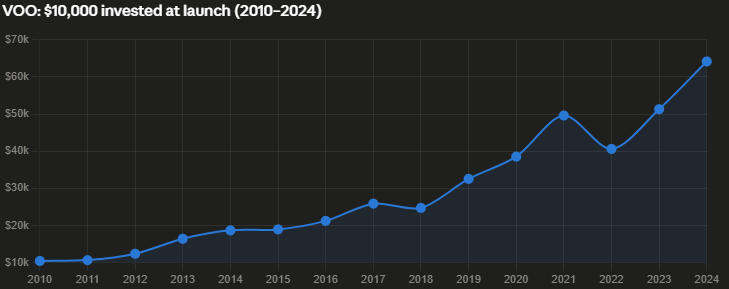
Source: Approximate VOO annual returns since inception (2010). Past performance does not guarantee future results.
To put the inception return in perspective: $10,000 invested in VOO at launch in 2010 would be worth over $70,000 by 2024 — without adding a single extra dollar.
Of course, that period included some rough years too — VOO dropped 18% in 2022. But long-term investors who stayed the course came out well ahead.
How Do You Make Money with VOO?
Two ways:
1. Price Appreciation
As the 500 companies in VOO grow in value, VOO’s share price rises. You profit when you sell at a higher price than you bought.
2. Dividends
VOO pays quarterly dividends — distributions of the dividend income collected from the companies it holds. As of 2025, VOO’s dividend yield is approximately 1.3–1.5% annually.
For example, if you hold $10,000 of VOO, you’d receive roughly $130–$150 per year in dividends, paid out in four quarterly installments.
Many long-term investors reinvest their dividends automatically — buying more VOO shares each quarter — which compounds their returns over time.
VOO vs. SPY vs. IVV: Which Should You Buy?
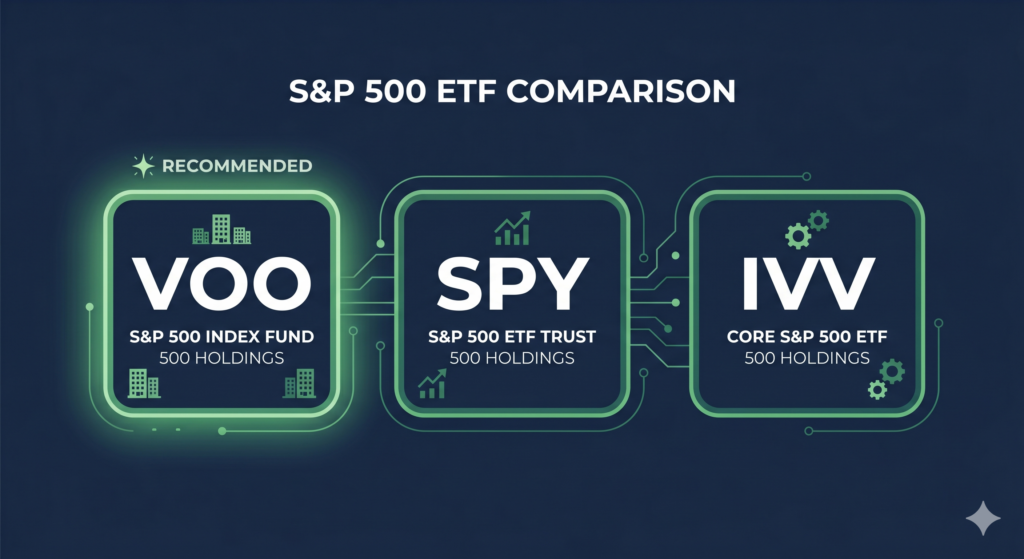
All three ETFs track the S&P 500. So what’s the difference?
| VOO | SPY | IVV | |
|---|---|---|---|
| Issuer | Vanguard | State Street | BlackRock |
| Expense ratio | 0.03% | 0.0945% | 0.03% |
| Launched | 2010 | 1993 | 2000 |
| AUM | ~$600B | ~$600B | ~$500B |
| Dividend reinvestment | Efficient | Less efficient | Efficient |
| Best for | Long-term investors | Active traders | Long-term investors |
For long-term buy-and-hold investors: VOO or IVV are the better choices due to their lower expense ratios and more tax-efficient structure.
For active traders: SPY has the highest trading volume in the world, making it the preferred choice for short-term trades, options, and institutional investors.
For most everyday investors reading this blog? VOO is the go-to answer.
How to Actually Buy VOO
To buy VOO, you need a brokerage account. Here are the most popular options:
For U.S. residents:
- Fidelity — no account minimums, fractional shares available
- Charles Schwab — no account minimums, fractional shares available
- Vanguard — buying VOO directly from the issuer
For Korean residents in the U.S.: All of the above work. You’ll just need a Social Security Number (SSN) or Individual Taxpayer Identification Number (ITIN) to open a brokerage account.
Once your account is open and funded:
- Search for the ticker VOO
- Choose the number of shares (or dollar amount if fractional shares are available)
- Place a market order (buys at the current price) or limit order (buys only at your specified price)
- Confirm the order
That’s it. You’re now an investor in 500 of the largest U.S. companies.
Common Questions About VOO
“Should I buy VOO all at once or spread it out?”
This is the lump sum vs. dollar-cost averaging debate. Research consistently shows that lump sum investing outperforms dollar-cost averaging about 2/3 of the time — because markets tend to go up over time, so getting in earlier is usually better.
However, if investing a large amount at once makes you nervous (understandable), spreading purchases over 6–12 months is a perfectly reasonable approach that reduces the risk of buying right before a short-term dip.
“What if VOO drops right after I buy?”
It might. Short-term drops are normal and unpredictable. The key is your time horizon. If you won’t need the money for 10+ years, short-term drops are largely irrelevant — history shows the market has always recovered.
“Is VOO better than picking individual stocks?”
For most people — yes. Study after study shows that the vast majority of individual investors and even professional fund managers underperform the S&P 500 over a 10-year period. Simply owning VOO beats most active strategies over the long run.
“Can I lose all my money in VOO?”
Theoretically, VOO could go to zero — but only if all 500 companies in the S&P 500 went bankrupt simultaneously. That would require a collapse of the entire U.S. economy. In any scenario where that happens, frankly, investment returns would be the least of everyone’s concerns.
Is VOO Right for You?
VOO is a great fit if:
- ✅ You want a simple, low-cost investment
- ✅ You have a long time horizon (5+ years, ideally 10+)
- ✅ You want broad exposure to the U.S. economy
- ✅ You don’t want to spend time researching individual stocks
VOO might not be enough if:
- You want international diversification (consider adding VEU or VXUS)
- You want small-cap exposure (consider adding VB or VTI instead)
- You need income beyond ~1.5% dividend yield (consider dividend-focused ETFs)
Key Terms to Remember
| Term | Simple Definition |
|---|---|
| VOO | Vanguard’s S&P 500 ETF |
| Vanguard | Investment company that created VOO; owned by its investors |
| Expense ratio | Annual fee (VOO charges just 0.03%) |
| Dividend yield | Annual dividend payment as a % of share price |
| Lump sum investing | Investing all at once |
| Dollar-cost averaging | Spreading investments over time |
| AUM | Assets Under Management — total money in the fund |
CPA Insight: VOO Dividends and the Cost Basis Trap
VOO pays quarterly dividends — and most of them qualify as “qualified dividends,” taxed at favorable
long-term capital gains rates (0%, 15%, or 20%) rather than ordinary income rates.
But here’s a trap I see constantly with clients who use dividend reinvestment (DRIP):
Every reinvested dividend is a taxable event AND it increases your cost basis. If you don’t track
those reinvested dividends carefully, you risk paying capital gains tax on the same money twice
when you eventually sell — once when the dividend was paid, and again because you forgot to add it
to your cost basis.
Pro tip: use “Specific Identification” as your cost basis method rather than the default FIFO (First In,
First Out). This lets you choose which shares to sell and can significantly reduce your tax bill — especially
if some shares have a higher cost basis than others.
Final Thoughts
VOO isn’t exciting. It won’t make you rich overnight. It won’t give you a story to tell at a dinner party about that one stock you picked that went up 500%.
But for most people building long-term wealth, boring is exactly what you want. Low cost, diversified, and historically reliable — VOO has earned its reputation as the default investment recommendation for a reason.
In the next post, we’ll look at how VOO compares to QQQ — the tech-heavy NASDAQ-100 ETF that has outperformed VOO significantly in recent years but comes with more volatility. Is the higher return worth the extra risk?
See you there.
— BaselineJay
Disclaimer: This post is for informational and educational purposes only. While the author is a licensed CPA, this content does not constitute professional financial, investment, or tax advice. Always consult a qualified professional for advice specific to your situation.
Previously: What is the S&P 500? And Why Does Everyone Talk About It? ←