You’ve decided to watch a baseball game. You turn it on, and within the first five minutes someone gets called out on strikes, a runner is thrown out trying to steal second, and the announcer says “full count, two outs, runner on third.”
You have no idea what any of that means.
Don’t worry — that was me once too.
Baseball has a reputation for being complicated, but the core rules are actually very logical once someone explains them clearly. By the end of this post, you’ll be able to watch a game and actually understand what’s happening.
Let’s go.
The Basic Idea
At its core, baseball is simple:
- One team tries to score runs (offense)
- The other team tries to stop them (defense)
- After a set number of opportunities, the team with more runs wins
The offense sends one batter at a time to home plate. The defense tries to get three outs. Once three outs are recorded, the teams switch roles.
That’s the foundation. Everything else builds on this.
The Field
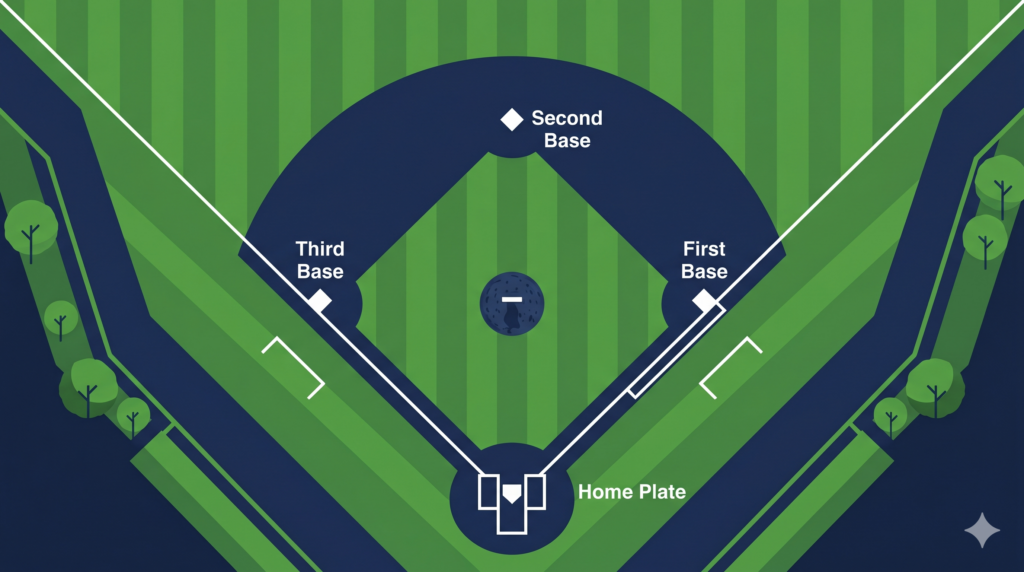
Before we get into the rules, it helps to visualize the playing area.
A baseball field has two main sections:
The Infield — a diamond shape with four bases:
- Home plate — where the batter stands and where runs are scored
- First base — 90 feet from home plate
- Second base — directly across from home plate
- Third base — completing the square
The Outfield — the large grassy area beyond the infield, bounded by the outfield wall.
The pitcher’s mound sits in the center of the diamond, 60 feet 6 inches from home plate. This is where the pitcher throws from.
A foul line runs from home plate through first base and another through third base, extending to the outfield wall. Balls landing inside these lines are in fair territory. Balls outside are foul.
Innings and Outs
A standard MLB game consists of 9 innings.
Each inning has two halves:
- Top of the inning — the visiting team bats
- Bottom of the inning — the home team bats
Each half-inning ends when the defensive team records 3 outs.
So in a complete 9-inning game, each team gets 9 chances (half-innings) to score runs.
If the game is tied after 9 innings, it goes to extra innings — continuing until one team leads at the end of a complete inning.
How Outs Are Made
Getting batters and runners out is the defense’s main job. There are several ways to do it:
Strikeout
The most iconic out in baseball. A batter receives 3 strikes and is out.
A strike is called when:
- The batter swings and misses
- The batter doesn’t swing at a pitch in the strike zone (the area roughly between the batter’s knees and chest, over home plate)
- The batter hits a foul ball (but a foul ball cannot be the third strike, with one exception)
Fly Out
The batter hits the ball into the air and a fielder catches it before it hits the ground. The batter is immediately out.
Ground Out
The batter hits the ball on the ground. A fielder picks it up and throws to first base before the batter arrives. Out.
Tag Out
A fielder with the ball physically tags a baserunner who is not standing on a base. Out.
Force Out
When a runner is forced to advance because the batter becomes a runner, a fielder can get the out by simply touching the base with the ball before the runner arrives — no tag needed.
Balls and Strikes: The Count
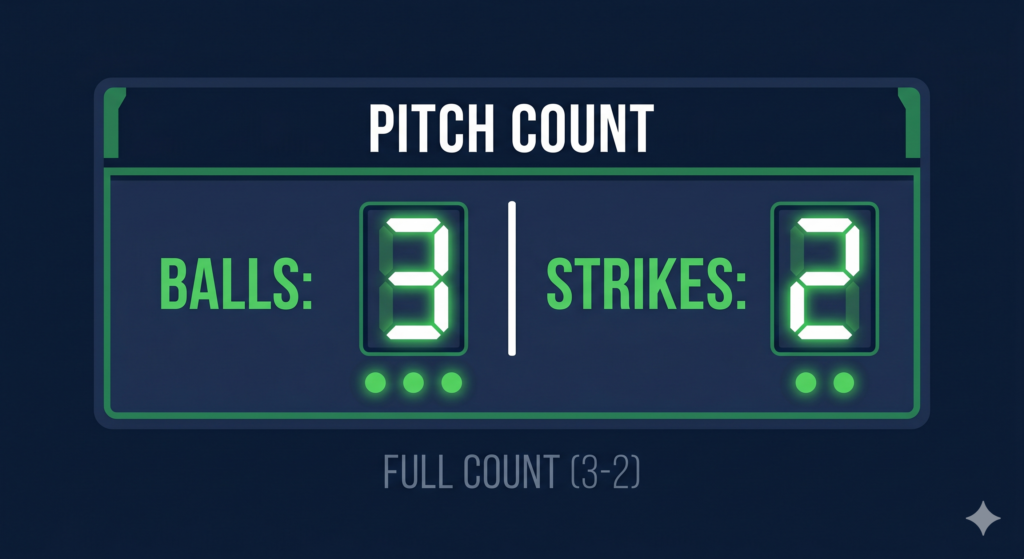
Every at-bat has a count — the number of balls and strikes on the current batter.
Balls are pitches that miss the strike zone and the batter doesn’t swing at. After 4 balls, the batter automatically advances to first base. This is called a walk (or base on balls).
Strikes are either swings and misses, pitches in the zone the batter doesn’t swing at, or foul balls. After 3 strikes, the batter is out.
The count is always expressed as balls-strikes:
| Count | Meaning |
|---|---|
| 0-0 | No balls, no strikes (start of at-bat) |
| 3-0 | 3 balls, 0 strikes (pitcher is struggling) |
| 0-2 | 0 balls, 2 strikes (batter in trouble) |
| 3-2 | 3 balls, 2 strikes — called a full count |
A full count (3-2) is the most exciting count — one more ball means a walk, one more strike means an out. The batter almost always swings.
How Runs Are Scored
The goal of the offense is to score runs.
A run is scored when a player successfully advances around all four bases — first, second, third, and home — and touches home plate.
Here’s how runners get on base:
Hit — the batter hits the ball into fair territory and reaches base safely before the ball gets there.
- Single — reaches first base
- Double — reaches second base
- Triple — reaches third base
- Home Run — hits the ball over the outfield wall; all runners (including the batter) automatically score
Walk — 4 balls; batter takes first base
Hit by Pitch (HBP) — the pitch hits the batter; they take first base
Error — a fielder makes a mistake that allows the batter to reach base
Once on base, runners advance by:
- The next batter getting a hit
- A walk that forces them forward
- A stolen base — the runner sprints to the next base while the pitcher is throwing
The Defense: 9 Players, 9 Positions
The defensive team has 9 players on the field at once, each assigned a specific position:
| # | Position | Role |
|---|---|---|
| 1 | Pitcher (P) | Throws pitches from the mound |
| 2 | Catcher (C) | Crouches behind home plate; receives pitches |
| 3 | First Baseman (1B) | Covers first base |
| 4 | Second Baseman (2B) | Covers the area near second base |
| 5 | Third Baseman (3B) | Covers third base |
| 6 | Shortstop (SS) | Between second and third; most demanding infield position |
| 7 | Left Fielder (LF) | Covers left side of outfield |
| 8 | Center Fielder (CF) | Covers center of outfield; usually the fastest outfielder |
| 9 | Right Fielder (RF) | Covers right side of outfield |
The Home Run
No play in baseball generates more excitement than the home run.
When a batter hits the ball over the outfield wall in fair territory, it’s an automatic home run. The batter — and any runners already on base — automatically score. No defense can stop it.
A grand slam is a home run with the bases loaded (runners on first, second, and third) — scoring 4 runs at once. The rarest and most exciting offensive play in the sport.
A Few Rules That Confuse Beginners
The Infield Fly Rule
If there are runners on first and second (or bases loaded) with fewer than two outs, and a batter hits a pop-up in the infield that a fielder can catch easily, the batter is automatically called out — even if the fielder drops it. This prevents the defense from intentionally dropping the ball to create a double play.
The Balk
A pitcher must come to a complete stop before pitching when runners are on base. Any illegal movement is called a balk, and all runners automatically advance one base.
Foul Ball on Two Strikes
A foul ball counts as a strike — but NOT for the third strike. A batter can keep fouling off pitches indefinitely on a two-strike count. (Exception: a foul tip caught by the catcher on strike three counts as a strikeout.)
How a Typical Half-Inning Looks
Let’s walk through a quick example:
Batter 1: Hits a single → Runner on first
Batter 2: Hits a double → Runner scores from first,
          batter on second (1-0)
Batter 3: Strikes out → 1 out
Batter 4: Hits a fly ball, caught → 2 outs
Batter 5: Walks → Runners on first and second
Batter 6: Hits a ground ball, fielder throws to second
          for a force out → 3 outs, half-inning over
Final result: 1 run scored, 3 outs made. Defense takes the field.
Key Terms to Remember
| Term | Simple Definition |
|---|---|
| Inning | One round of play; each team bats once |
| Strike | A pitch swung at and missed, or in the zone untouched |
| Ball | A pitch outside the zone that the batter doesn’t swing at |
| Walk | 4 balls; batter advances to first base |
| Full count | 3 balls, 2 strikes |
| Hit | Batter reaches base safely on a batted ball |
| Home run | Ball hit over the outfield wall; automatic run(s) scored |
| RBI | Run Batted In — credit given to a batter when a runner scores due to their hit |
| Stolen base | A runner advances to the next base without the ball being hit |
| Double play | Two outs recorded on a single play |
Final Thoughts
Baseball’s rules reward patience — both in learning them and in playing the game. Once the basic framework clicks, you’ll start to notice the layers of strategy underneath every pitch, every count, and every baserunning decision.
In the next post, we’ll start looking at how those plays are recorded — the traditional statistics that baseball fans have used for over a century to measure a player’s performance. Batting average, home runs, RBIs, ERA, and more.
See you there.
— BaselineJay
Disclaimer: This post is for informational and educational purposes only. All rules referenced are based on official MLB rulebook guidelines.
Previously: What is MLB? A Beginner’s Guide to Baseball Structure & History ←
Up Next: Traditional Batting Stats Explained: AVG, HR, RBI, OBP →