In the last post, we covered what a stock is — a small piece of ownership in a company. If you haven’t read that yet, I’d recommend starting there first.
Today, we’re going one step further. We’re talking about ETFs — one of the most powerful and beginner-friendly investment tools available today.
If you’ve ever felt overwhelmed trying to pick individual stocks, ETFs might just be the answer you’ve been looking for.
What is an ETF?
ETF stands for Exchange-Traded Fund.
Let’s break that down:
- Exchange-Traded — it’s bought and sold on a stock exchange, just like a regular stock
- Fund — it holds a collection of many different investments inside it
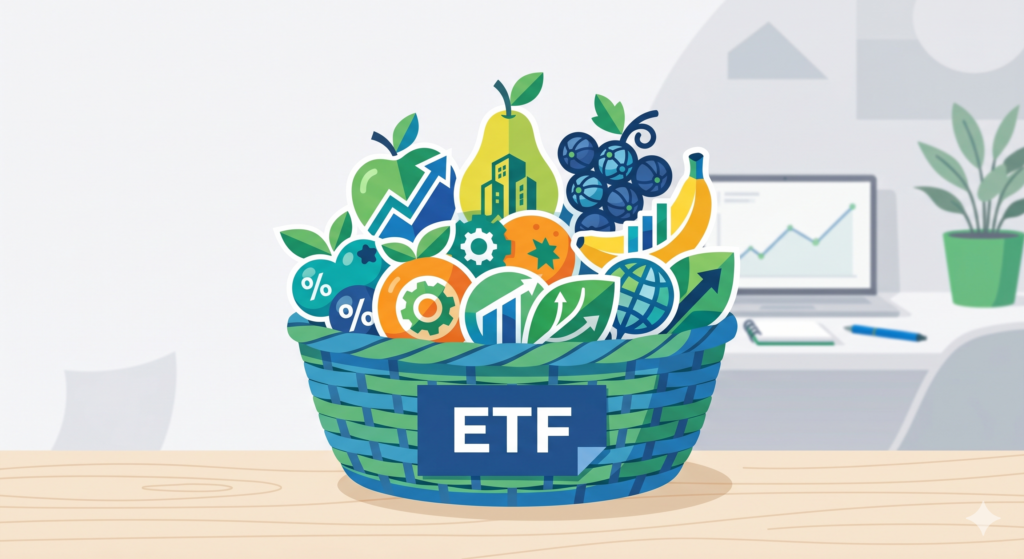
In simple terms, an ETF is a basket of stocks (or other assets) that you can buy in a single purchase.
Instead of buying Apple stock, then Microsoft stock, then Google stock separately, you can buy one ETF that holds all of them — and hundreds more — at once.
A Simple Analogy
Think about buying fruit.
You could go to the store and carefully pick out one apple, one orange, one banana — spending time and money on each one individually. Or you could just grab a pre-made fruit basket that already has a great variety inside.
An ETF is that fruit basket.
You get instant variety, you save time, and if one piece of fruit goes bad (one company struggles), the rest of the basket is still fine.
How Does an ETF Actually Work?
Here’s the basic flow:
1. A fund company creates the ETF Companies like Vanguard, BlackRock (iShares), or State Street create ETFs. They decide what the ETF will hold — for example, “we’ll hold the 500 largest U.S. companies.”
2. They buy all those stocks inside the fund The fund company actually goes out and buys shares of all those companies. The ETF now “contains” all of them.
3. They list the ETF on a stock exchange Just like Apple or Tesla, the ETF gets a ticker symbol (like VOO or SPY) and is listed on the NYSE or NASDAQ.
4. You buy shares of the ETF When you buy one share of the ETF, you’re essentially buying a tiny piece of every single company inside it.
It’s that straightforward.
What Can an ETF Hold?
Most people think ETFs only hold stocks — but they can hold all kinds of assets:
| Type | Example ETF | What it holds |
|---|---|---|
| Stock ETF | VOO | 500 largest U.S. companies |
| Bond ETF | BND | U.S. government & corporate bonds |
| Sector ETF | XLK | Tech companies only |
| International ETF | VEU | Stocks from non-U.S. countries |
| Dividend ETF | VYM | High dividend-paying companies |
| Commodity ETF | GLD | Gold |
For most beginners, stock ETFs are the starting point — and that’s what we’ll focus on throughout this series.
Why Are ETFs So Popular?
ETFs have exploded in popularity over the last two decades, and for good reason. Here’s what makes them so appealing:
1. Instant Diversification
When you buy one ETF like VOO, you’re instantly invested in 500 companies across every major industry — technology, healthcare, finance, energy, and more.
If one company tanks, it barely affects your overall investment. Compare that to owning just one stock, where a bad earnings report can wipe out 20% of your money overnight.
2. Low Cost
ETFs are incredibly cheap to own. Most broad market ETFs charge an expense ratio (annual fee) of just 0.03% to 0.20%.
That means for every $10,000 you invest, you pay $3 to $20 per year in fees. Compare that to actively managed mutual funds that often charge 1% or more ($100+ per year on $10,000).
Over decades, this difference in fees compounds into thousands — sometimes tens of thousands — of dollars.
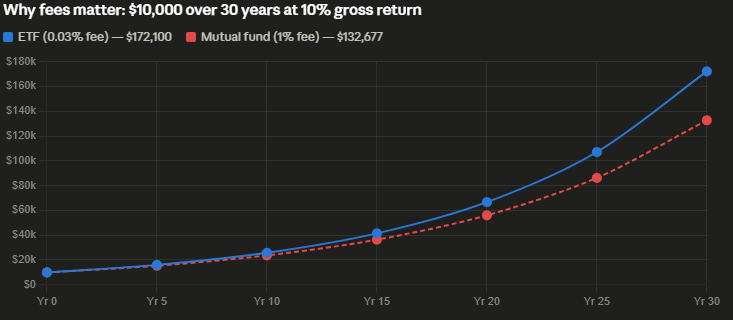
Source: Hypothetical illustration assuming 10% gross annual return over 30 years. Fees based on Vanguard VOO (0.03%) and a typical actively managed mutual fund (1%).
3. Easy to Buy and Sell
Unlike some investment products, ETFs trade throughout the day on the stock exchange. You can buy or sell them anytime the market is open, just like a regular stock.
4. Transparency
ETFs are required to publicly disclose what they hold. You always know exactly what’s inside your ETF — no surprises.
5. Tax Efficiency
ETFs are structured in a way that typically generates fewer taxable events compared to mutual funds. This means you keep more of your returns. (We’ll cover ETF tax strategy in a future post.)
ETF vs. Individual Stock — Which is Better for Beginners?
This is one of the most common questions I get. Here’s the honest answer:

For most beginners, ETFs are the better starting point.
Here’s why:
Picking individual stocks requires deep research, constant monitoring, and a high tolerance for volatility. Even professional fund managers — with entire teams of analysts — struggle to consistently beat the market.
Warren Buffett himself has said that for most investors, a simple S&P 500 index ETF is a better choice than trying to pick individual stocks.
That doesn’t mean individual stocks are bad — they have a place in a portfolio. But if you’re just starting out, building a foundation with ETFs first makes a lot of sense.
ETF vs. Mutual Fund — What’s the Difference?
You might hear mutual funds mentioned alongside ETFs. They’re similar in concept — both hold a basket of assets — but there are key differences:
| ETF | Mutual Fund | |
|---|---|---|
| Trading | Anytime during market hours | Once per day after market close |
| Minimum investment | Price of 1 share (sometimes $1+) | Often $1,000–$3,000 minimum |
| Fees | Generally very low | Can be high (especially actively managed) |
| Tax efficiency | More tax efficient | Less tax efficient |
For most everyday investors today, ETFs have become the preferred choice over traditional mutual funds.
What Are the Most Popular ETFs?
Here are some of the most widely held ETFs in the world — you’ll hear these names a lot:
VOO (Vanguard S&P 500 ETF) Tracks the S&P 500 — the 500 largest U.S. companies. One of the most popular ETFs ever created.
SPY (SPDR S&P 500 ETF Trust) Also tracks the S&P 500. The oldest and most traded ETF in the world.
QQQ (Invesco QQQ Trust) Tracks the Nasdaq-100 — heavily weighted toward tech companies like Apple, Microsoft, and Nvidia.
VTI (Vanguard Total Stock Market ETF) Holds virtually every publicly traded U.S. company — over 3,500 stocks.
We’ll do deep dives on each of these in upcoming posts. For now, just get familiar with the names.
How Do You Make Money with ETFs?
Just like individual stocks, there are two ways:
1. Price appreciation If the companies inside the ETF grow in value, the ETF price goes up. You profit when you sell at a higher price than you bought.
2. Dividends Many ETFs pass along dividends from the companies they hold directly to you, usually on a quarterly basis.
For example, VOO has historically paid a quarterly dividend and delivered strong long-term price appreciation — making it a favorite for both income and growth investors.
Is Investing in ETFs Risk-Free?
No — and it’s important to be clear about this.
ETFs can and do go down in value. When the overall market drops, your ETF drops too. In 2022, VOO dropped over 18% for the year as the Fed raised interest rates aggressively.
But here’s the key: broad market ETFs have historically recovered from every downturn.
The longer your time horizon, the more that history works in your favor. Investors who stayed patient through 2022 saw VOO bounce back and reach new all-time highs in 2023 and 2024.
The risk isn’t in owning ETFs — it’s in panic-selling during downturns.
Key Terms to Remember
| Term | Simple Definition |
|---|---|
| ETF | A basket of stocks or assets traded like a single stock |
| Ticker symbol | The short code for an ETF (e.g., VOO, SPY, QQQ) |
| Expense ratio | The annual fee charged by the ETF (e.g., 0.03%) |
| Index | A list of companies an ETF tracks (e.g., S&P 500) |
| Diversification | Spreading investments across many assets to reduce risk |
CPA Insight: Why ETFs Are More Tax-Efficient Than Mutual Funds
This is one of the most underappreciated advantages of ETFs — and it’s rooted in how they’re structured.
When mutual fund investors redeem their shares, the fund manager must sell securities to raise cash.
Those sales trigger capital gains — which are distributed to ALL shareholders, even those who
didn’t sell anything. You can get a tax bill simply for holding a mutual fund while someone else sold.
ETFs avoid this through a mechanism called “in-kind redemption.” Large institutional investors exchange baskets of the underlying stocks directly for ETF shares — no cash sale, no taxable event for regular investors.
The result: ETF holders typically pay capital gains only when they personally choose to sell. You control
the timing of your tax bill. That’s a significant advantage — especially in a taxable brokerage account.
Final Thoughts
ETFs are one of the simplest, most cost-effective ways to start investing — and they’re what even the world’s greatest investors recommend for most people.
In the next post, we’ll zoom in on the most famous index of all — the S&P 500 — and explain why everyone from Wall Street to Main Street talks about it constantly.
See you there.
— BaselineJay
Disclaimer: This post is for informational and educational purposes only. While the author is a licensed CPA, this content does not constitute professional financial, investment, or tax advice. Always consult a qualified professional for advice specific to your situation.
Previously: What is a Stock? Understanding the Basics of Investing ←
Up Next: What is the S&P 500? And Why Does Everyone Talk About It? →