If you’ve ever heard someone say “I bought Apple stock” or “the market crashed today” and had absolutely no idea what that meant — you’re in the right place.

Investing can feel like a foreign language at first. But here’s the truth: the basics are actually pretty simple. In this post, we’re going to break down exactly what a stock is, why companies sell them, and why millions of people around the world buy them every single day.
No jargon. No complicated math. Just a clear, honest explanation from someone who’s been in your shoes.
So… What Exactly is a Stock?
Let’s start with the most basic question.
A stock is a small piece of ownership in a company.
That’s it. When you buy a stock, you’re buying a tiny slice of that business. If the company does well, your slice becomes more valuable. If the company struggles, your slice loses value.
Think of it this way: imagine your friend is opening a restaurant and needs $100,000 to get started. She splits that ownership into 1,000 equal pieces (called shares), each worth $100. You buy 10 shares for $1,000. Now you own 1% of the restaurant.
If the restaurant becomes a huge hit and is now worth $500,000, your 1% stake is worth $5,000. You just turned $1,000 into $5,000 — simply by owning a small piece of something that grew.
That’s the core idea behind stocks.
Why Do Companies Sell Stocks?
Good question. Why would a company give away ownership?
The answer is simple: they need money to grow.
When a company wants to expand — build new factories, hire more employees, develop new products — it needs capital. Instead of borrowing all that money from a bank (and paying it back with interest), a company can sell ownership stakes to the public.
This process is called an IPO (Initial Public Offering) — the moment a private company first offers its shares to everyday investors on the stock market.
Famous IPO examples you might recognize:
- Apple went public in 1980 at $22 per share
- Google went public in 2004 at $85 per share
- Amazon went public in 1997 at $18 per share
If you had bought just $1,000 of Amazon stock at its IPO, it would be worth over $1.5 million today.
Of course, not every company turns into Amazon. But that’s the potential upside of owning stocks.
How Do You Actually Make Money from Stocks?
There are two main ways:
1. Capital Gains (Price Appreciation)
This is the most common way. You buy a stock at one price, and later sell it at a higher price.
For example:
- You buy 10 shares of a company at $50 each → you spend $500
- The stock price rises to $80 per share
- You sell your 10 shares → you receive $800
- Your profit: $300
Simple math. The goal is to buy low and sell high.
2. Dividends
Some companies — especially well-established ones — share a portion of their profits directly with shareholders. These payments are called dividends.
For example, if a company pays a $2 annual dividend per share and you own 100 shares, you receive $200 per year just for holding the stock. No buying or selling required.
Think of dividends as a “thank you” payment from the company for being an investor.
Where Are Stocks Bought and Sold?
Stocks are traded on stock exchanges — basically organized marketplaces where buyers and sellers come together.
The two most well-known exchanges in the U.S. are:
- NYSE (New York Stock Exchange) — home to companies like Coca-Cola, JPMorgan, and Walmart
- NASDAQ — home to most tech giants like Apple, Microsoft, Google, and Meta
You don’t need to physically go to these exchanges. Today, you can buy and sell stocks from your phone in seconds through brokerage apps like Fidelity, Charles Schwab, or Robinhood.
What Makes Stock Prices Go Up and Down?
This is where a lot of beginners get confused — and honestly, even experienced investors don’t always get it right.
Stock prices change based on supply and demand. When more people want to buy a stock than sell it, the price goes up. When more people want to sell than buy, the price goes down.
But what drives that buying and selling? Lots of things:
- Company earnings — Did the company make more money than expected? Stock often goes up.
- Economic news — Interest rates, inflation, unemployment — these affect the whole market.
- Industry trends — Is the sector growing or shrinking?
- Investor sentiment — Sometimes stocks move simply because people feel optimistic or fearful.
This is why the stock market can feel unpredictable in the short term. Over the long term, however, the market has historically trended upward — which is why long-term investing has been one of the most reliable ways to build wealth.
Is Investing in Stocks Risky?
Yes — and it’s important to be honest about that.
Stock prices can go down. Companies can fail. Markets can crash. In 2008, the S&P 500 dropped nearly 50% during the financial crisis. In early 2020, it dropped 34% in just 33 days when COVID-19 hit.
But here’s the other side of that story: the market recovered both times — and went on to reach new all-time highs.
The key insight is this: risk and time are closely connected. The longer you stay invested, the more time the market has to recover from downturns. Historically, investors who stayed patient through crashes ended up better off than those who panicked and sold.
That doesn’t mean you should put money you need next month into stocks. But for money you don’t need for 5, 10, or 20+ years? Stocks have historically been hard to beat.
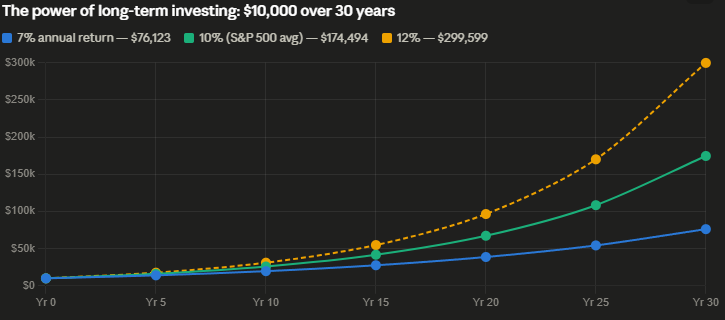
Source: Calculated based on historical average annual returns. For illustrative purposes only.
Stocks vs. Individual Stocks vs. ETFs — What’s the Difference?
You might have heard the term ETF thrown around. We’ll cover ETFs in depth in the next post, but here’s a quick preview:
- Individual stock = owning one company (e.g., just Apple)
- ETF = owning a basket of many companies at once (e.g., the top 500 U.S. companies)
Think of an ETF like a fruit basket. Instead of betting everything on one apple, you get a little of every fruit. More variety = less risk if one piece goes bad.
Most financial experts — including Warren Buffett — recommend ETFs for everyday investors rather than trying to pick individual stocks.
Key Terms to Remember
Before we wrap up, here are the essential terms from this post:
| Term | Simple Definition |
|---|---|
| Stock | A small piece of ownership in a company |
| Share | One unit of a stock |
| IPO | When a company first sells shares to the public |
| Dividend | A cash payment from a company to its shareholders |
| Capital Gain | Profit made from selling a stock at a higher price |
| NYSE / NASDAQ | The main U.S. stock exchanges |
| ETF | A basket of many stocks bundled into one investment |
CPA Insight: How Stocks Are Taxed
One thing most beginner investors overlook is the tax difference between short-term and long-term gains.
If you sell a stock within 12 months of buying it, your profit is taxed as ordinary income — up to 37%
depending on your tax bracket. Hold it for more than 12 months? You qualify for long-term capital gains rates: 0%, 15%, or 20%.
For most middle-income investors, that’s the difference between paying 22% and paying 15% on
the same gain. The IRS essentially rewards patience.
One more thing: the Wash Sale Rule. If you sell a stock at a loss and buy the same (or “substantially
identical”) stock within 30 days before or after, the IRS disallows the tax loss. It’s one of the most
common mistakes I see clients make.
Final Thoughts
Stocks are one of the most powerful tools for building long-term wealth — but only if you understand what you’re buying and why.
The goal isn’t to get rich overnight. The goal is to put your money to work, let it grow over time, and make informed decisions along the way.
You’ve just taken the first step by understanding what a stock actually is. In the next post, we’ll take this one step further and talk about ETFs — one of the simplest and most effective ways for beginners to start investing.
See you there.
— BaselineJay
Disclaimer: This post is for informational and educational purposes only. While the author is a licensed CPA, this content does not constitute professional financial, investment, or tax advice. Always consult a qualified professional for advice specific to your situation.