If you’ve ever heard someone mention the World Series, seen Shohei Ohtani’s name all over the news, or wondered why so many Korean players are heading to America to play baseball — this post is for you.
MLB can seem complicated at first. 30 teams, 162 games per season, a postseason system that takes weeks to figure out. But once you understand the basic structure, it all starts to make sense.
Let’s break it down from the very beginning.
What is MLB?
MLB stands for Major League Baseball.
It is the highest level of professional baseball in the world — the ultimate destination for the best baseball players from the United States, Latin America, Japan, Korea, and beyond.
MLB was officially founded in 1903 and is one of the four major professional sports leagues in North America, alongside the NFL (American football), NBA (basketball), and NHL (hockey).
Today, MLB consists of 30 teams spread across the United States and Canada, playing in front of tens of millions of fans every year.
A Brief History of Baseball
To understand MLB, it helps to know where baseball came from.
The Origins
Baseball evolved in the United States during the early 1800s, drawing from older bat-and-ball games played in England. By the mid-1800s, baseball had become a popular pastime in the northeastern U.S., with organized clubs forming in cities like New York and Boston.
The first professional baseball league — the National Association — was formed in 1871. It was replaced by the National League (NL) in 1876, which still exists today as one of MLB’s two leagues.
The American League and the Birth of MLB
In 1901, a rival organization called the American League (AL) was formed. After two years of competition, the two leagues agreed to coexist, and in 1903 they held the first World Series — a championship matchup between the AL and NL champions.
That agreement effectively created what we now call Major League Baseball.
Baseball’s Golden Age
The early-to-mid 1900s are often called baseball’s golden age. This era produced some of the most legendary players in sports history — Babe Ruth, who revolutionized the game with his home run hitting in the 1920s; Ted Williams, considered one of the greatest hitters ever; and Jackie Robinson, who in 1947 broke the color barrier, becoming the first Black player in MLB and changing American sports history forever.
The Modern Era
From the 1960s onward, baseball continued to evolve. Free agency was introduced in the 1970s, allowing players to negotiate contracts with any team — transforming the business of baseball forever.
The 1990s brought the Steroid Era, a controversial period of inflated statistics that still sparks debate today.
In the 2000s and 2010s, the rise of sabermetrics — advanced data-driven analysis popularized by the book and movie Moneyball — changed how teams evaluate players and make decisions. (We’ll cover sabermetrics in depth later in this series.)
Today, MLB is a multi-billion dollar industry with global reach — and players from Korea, Japan, the Dominican Republic, Venezuela, and Cuba are among its biggest stars.
How MLB is Structured
Two Leagues
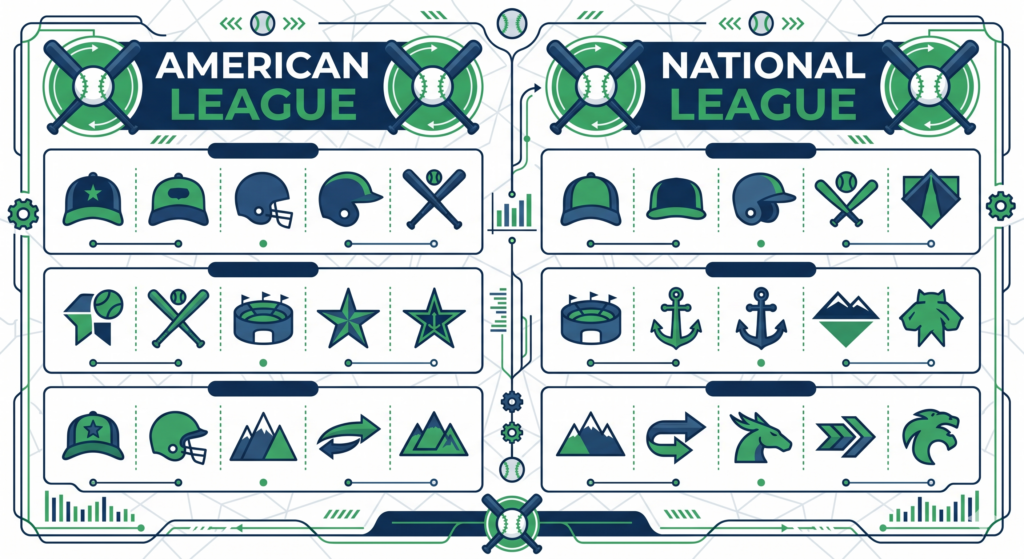
MLB is divided into two leagues:
- American League (AL) — 15 teams
- National League (NL) — 15 teams
Historically, the two leagues had one key difference: the AL used a designated hitter (DH) — a player who bats in place of the pitcher — while the NL did not. Since 2022, both leagues use the designated hitter.
Three Divisions Per League
Each league is divided into three divisions based on geography:
| League | Division | Example Teams |
|---|---|---|
| American League | AL East | New York Yankees, Boston Red Sox, Toronto Blue Jays |
| American League | AL Central | Chicago White Sox, Minnesota Twins, Cleveland Guardians |
| American League | AL West | Houston Astros, Los Angeles Angels, Seattle Mariners |
| National League | NL East | Los Angeles Dodgers, San Francisco Giants, San Diego Padres |
| National League | NL Central | Chicago Cubs, St. Louis Cardinals, Milwaukee Brewers |
| National League | NL West | Atlanta Braves, New York Mets, Philadelphia Phillies |
Note: The Dodgers are in the NL West despite being in Los Angeles.
How Does an MLB Season Work?
Spring Training (February – March)
Before the regular season begins, every team holds Spring Training in either Florida (the Grapefruit League) or Arizona (the Cactus League). Players get back into game shape, compete for roster spots, and coaches evaluate their teams.
Regular Season (Late March – September)
Each of the 30 teams plays 162 games over approximately six months — one of the longest regular seasons in professional sports.
Teams play within their division frequently, but also face teams from other divisions and the other league throughout the season.
The goal: finish with the best record possible to qualify for the postseason.
The Postseason (October)
The postseason — often called the playoffs or simply October Baseball — is where the season’s best teams compete for the World Series championship.
The postseason structure:
Wild Card Series (3 games)
→ Division Series / ALDS & NLDS (best of 5)
→ Championship Series / ALCS & NLCS (best of 7)
→ World Series (best of 7)
12 teams qualify for the postseason — the three division winners from each league plus three Wild Card teams from each league (the best remaining records).
The World Series, held each October, is the ultimate prize — the championship of Major League Baseball.
The Teams: 30 Franchises
Here’s a quick overview of all 30 MLB teams by division:
American League East New York Yankees, Boston Red Sox, Toronto Blue Jays, Baltimore Orioles, Tampa Bay Rays
American League Central Minnesota Twins, Chicago White Sox, Cleveland Guardians, Detroit Tigers, Kansas City Royals
American League West Houston Astros, Texas Rangers, Seattle Mariners, Los Angeles Angels, Oakland Athletics
National League East Atlanta Braves, New York Mets, Philadelphia Phillies, Miami Marlins, Washington Nationals
National League Central Milwaukee Brewers, Chicago Cubs, St. Louis Cardinals, Pittsburgh Pirates, Cincinnati Reds
National League West Los Angeles Dodgers, San Francisco Giants, San Diego Padres, Arizona Diamondbacks, Colorado Rockies
Korean Players in MLB
One of the most exciting storylines for Korean baseball fans in recent years has been the rise of Korean players in MLB.
The connection started with Park Chan-ho (박찬호), who in 1994 became the first Korean-born player to appear in an MLB game. His success paved the way for a generation of Korean players.
Today, some of the most talked-about players in MLB have Korean roots:
- Hyeseong Kim (김혜성) — Los Angeles Dodgers infielder known for his speed and defense
- Roki Sasaki — While Japanese, his Dodgers teammates include multiple Korean-connected players
The Dodgers in particular have become a favorite team for many Korean fans, partly due to the presence of Korean and Korean-connected players, and of course — Shohei Ohtani, who while Japanese, has become a global phenomenon playing in Los Angeles.
We’ll do dedicated deep-dives on Korean players in MLB later in this series.
Why Should You Follow MLB?
Whether you’re new to baseball or a KBO fan curious about the American game, here are a few reasons MLB is worth following:
The best players in the world The greatest talents from every baseball-playing country eventually make their way to MLB. If you want to see the highest level of the game, this is it.
162 games = endless content Unlike the NFL with 17 games per season, MLB plays 162 games. There’s always a game on, always a storyline to follow, always something to analyze.
Rich history and statistics Baseball is the most statistically documented sport in history. Every at-bat, every pitch, every play is tracked and analyzed. For data lovers, it’s paradise.
The Korean connection With multiple Korean players in MLB and the sport’s growing popularity in Korea, following MLB has never felt more relevant for Korean fans.
Key Terms to Remember
| Term | Simple Definition |
|---|---|
| MLB | Major League Baseball — the top professional baseball league in the world |
| AL / NL | American League and National League — the two leagues within MLB |
| Division | A geographic grouping of 5 teams within each league |
| Regular Season | 162-game season from late March to September |
| Postseason | The playoffs — 12 teams compete for the World Series |
| World Series | The MLB championship — best of 7 games |
| Spring Training | Pre-season camp in February and March |
| DH (Designated Hitter) | A player who bats in place of the pitcher |
| Wild Card | Playoff spots for non-division-winning teams with strong records |
Final Thoughts
MLB is more than just a sport — it’s a 150-year-old institution with a rich history, global talent, and some of the most passionate fans in the world.
Now that you understand the basic structure — the two leagues, the divisions, the 162-game season, and how the playoffs work — you’re ready to actually start following the game.
In the next post, we’ll get into the rules of baseball itself. How does a game actually work? What are strikes, balls, outs, and innings? We’ll cover everything you need to know to watch a game without feeling lost.
See you there.
— BaselineJay
Disclaimer: This post is for informational and educational purposes only. All statistics and historical references are based on publicly available information.
Up Next: Baseball Rules Explained: How a Game Actually Works →